
No.06Writing & scaffolding
Kātib
A writing companion to Readanah
From your first word to your own voice. Kātib walks learners up the whole ladder of writing — words, sentences, paragraphs, then a complete piece — for every Term 1 writing lesson, as a companion to Readanah.
- Audience
- Students & teachers · Cycle 2 & 3 · Grades 5–12
- Availability
- Live · Term 1, 2026–2027
- Chapter
- III · Reading & writing
- Type
- Platform · Writing & scaffolding
The classroom problem
Writing tasks often ask for a finished paragraph or essay from learners who are still unsure of the words and sentence patterns it needs. Without the steps in between, weaker writers copy, stall or hand in nothing — and stronger writers get no stretch.
Teachers need the scaffolds — word banks, frames, planners, checklists — matched to the lesson they are teaching, in a form they can print.
The response
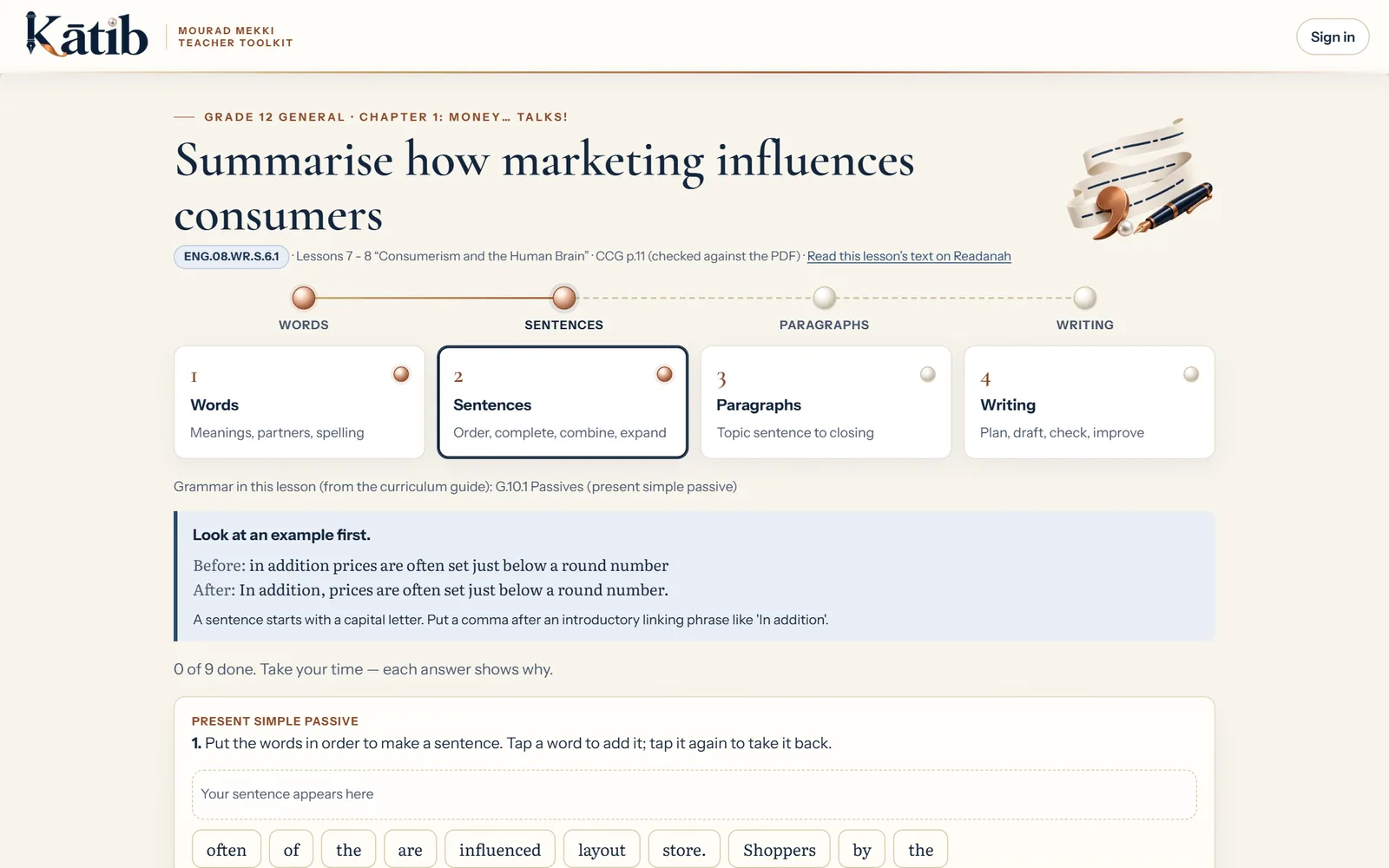
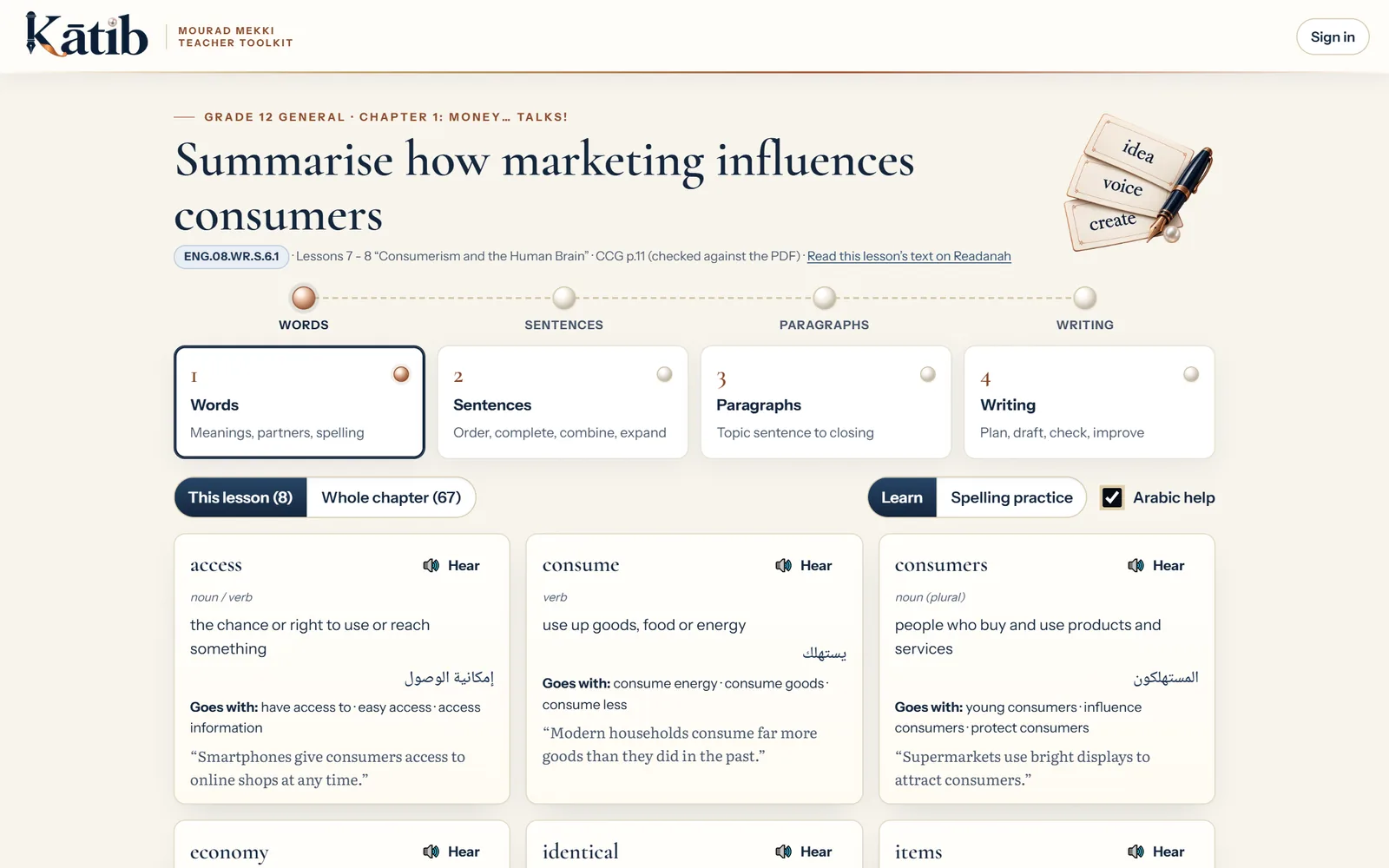
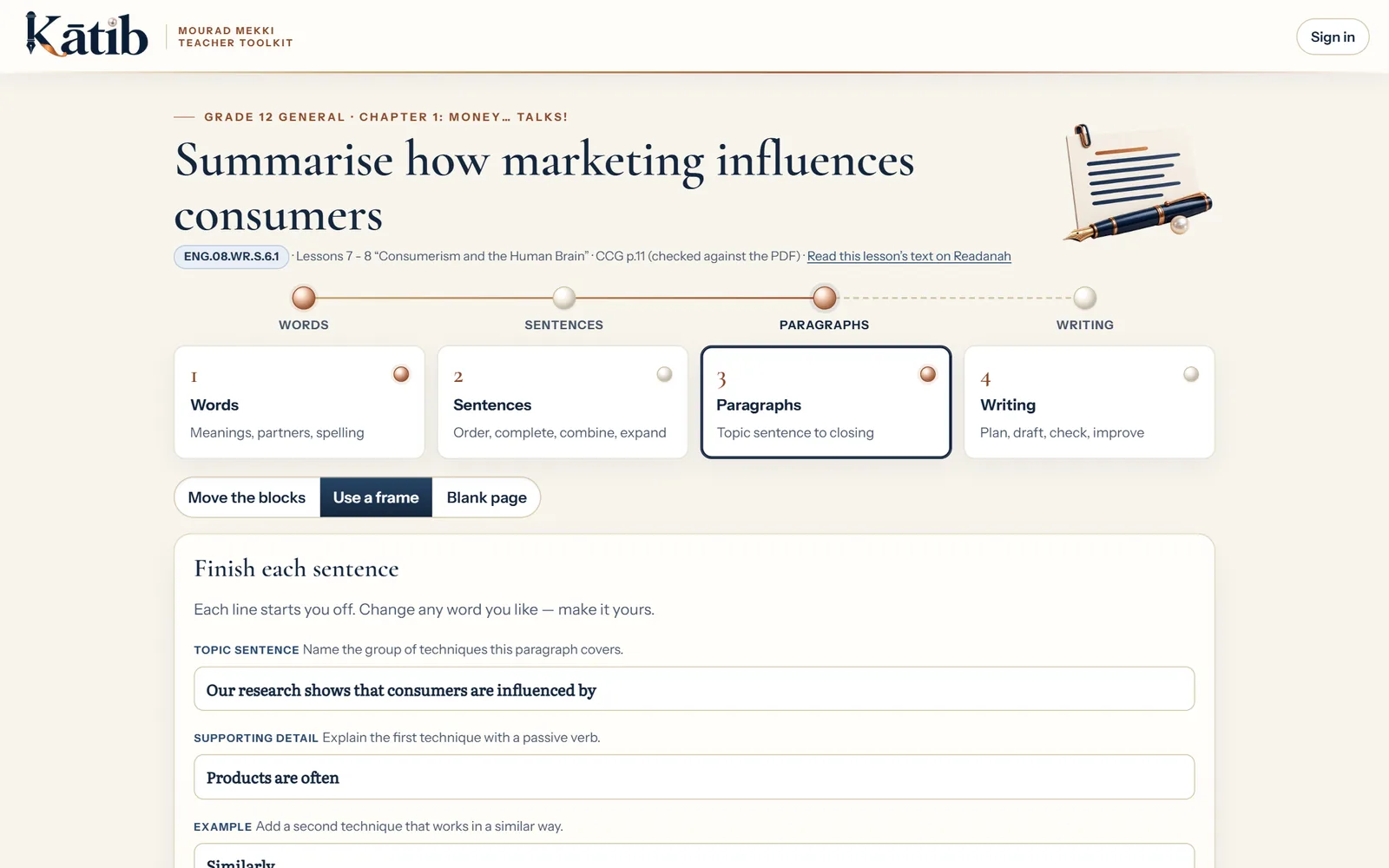
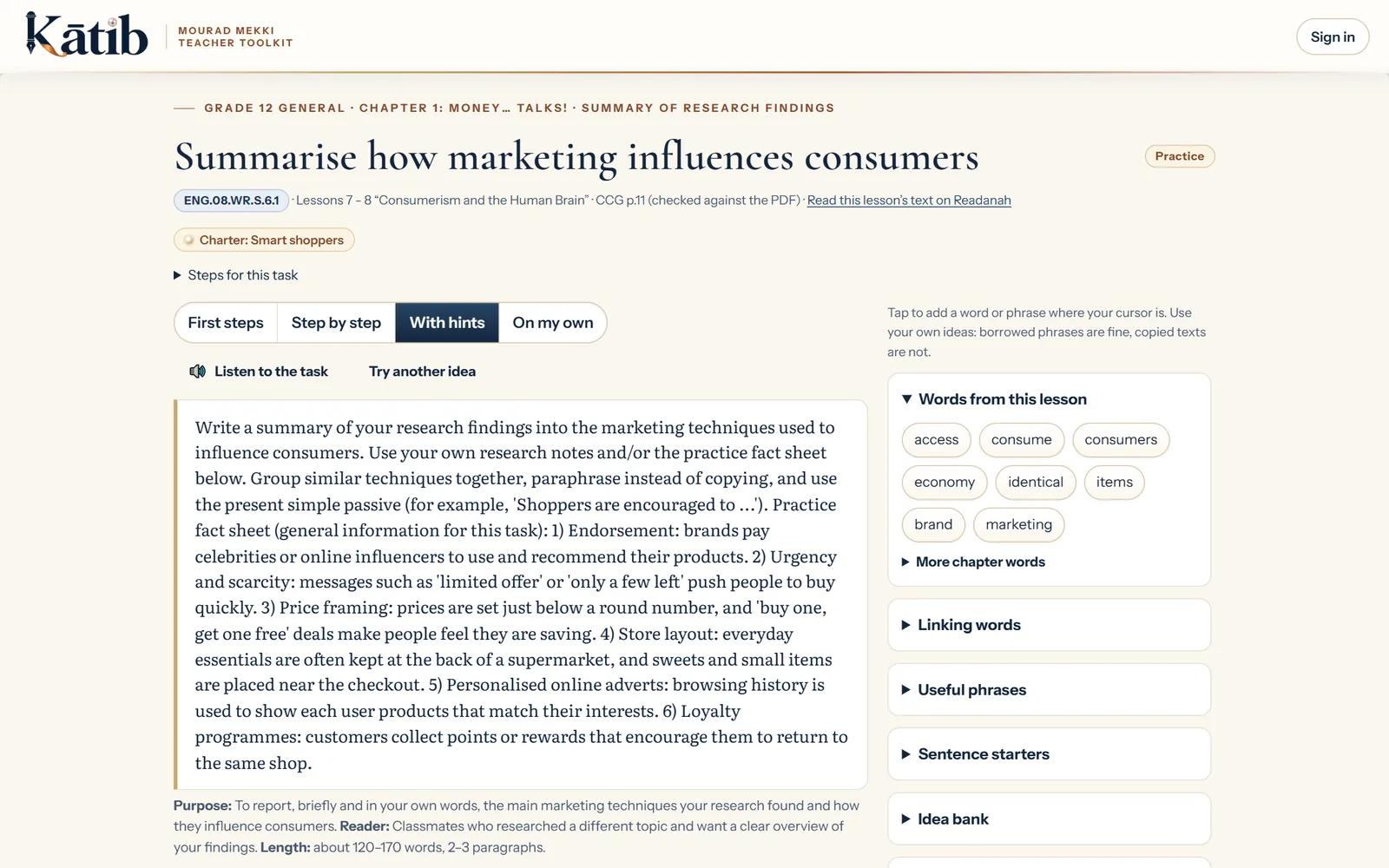
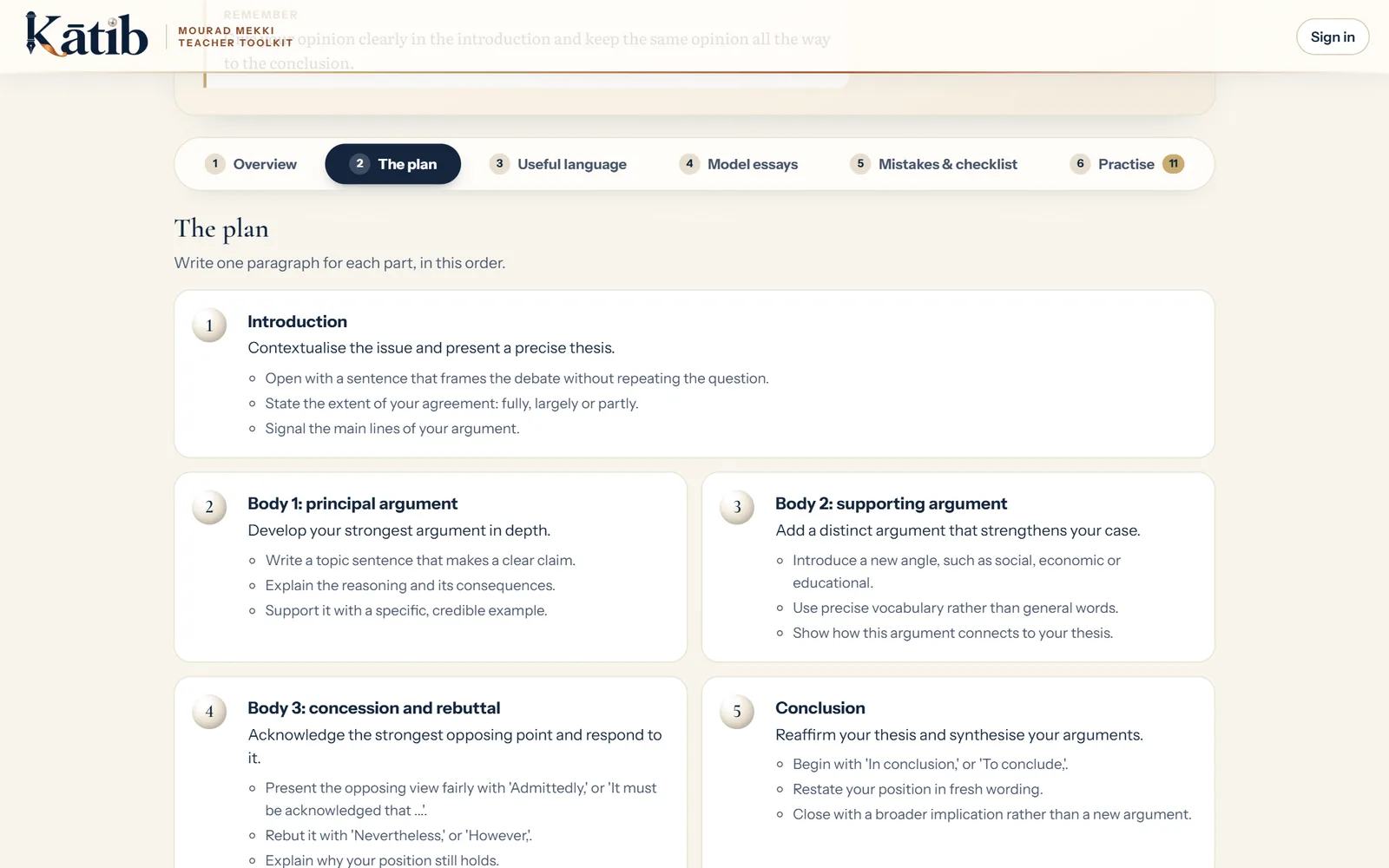
Each writing lesson is a ladder of four stages. Words: meanings, word partners and spelling, with optional Arabic help. Sentences: order, complete, combine and expand. Paragraphs: from topic sentence to closing, with a frame when it is needed. Writing: plan, draft, check and improve a genre task.
Four help levels — First steps, Step by step, With hints and On my own — change the support and the word target, not the task. The example text opens only after a first try, and checks run on the device: Kātib gives guidance, never a mark.
A Free writing area adds five essay types at three bands, each with model essays and a plan. Every lesson links to the matching Readanah text, so reading and writing can follow the same lesson.
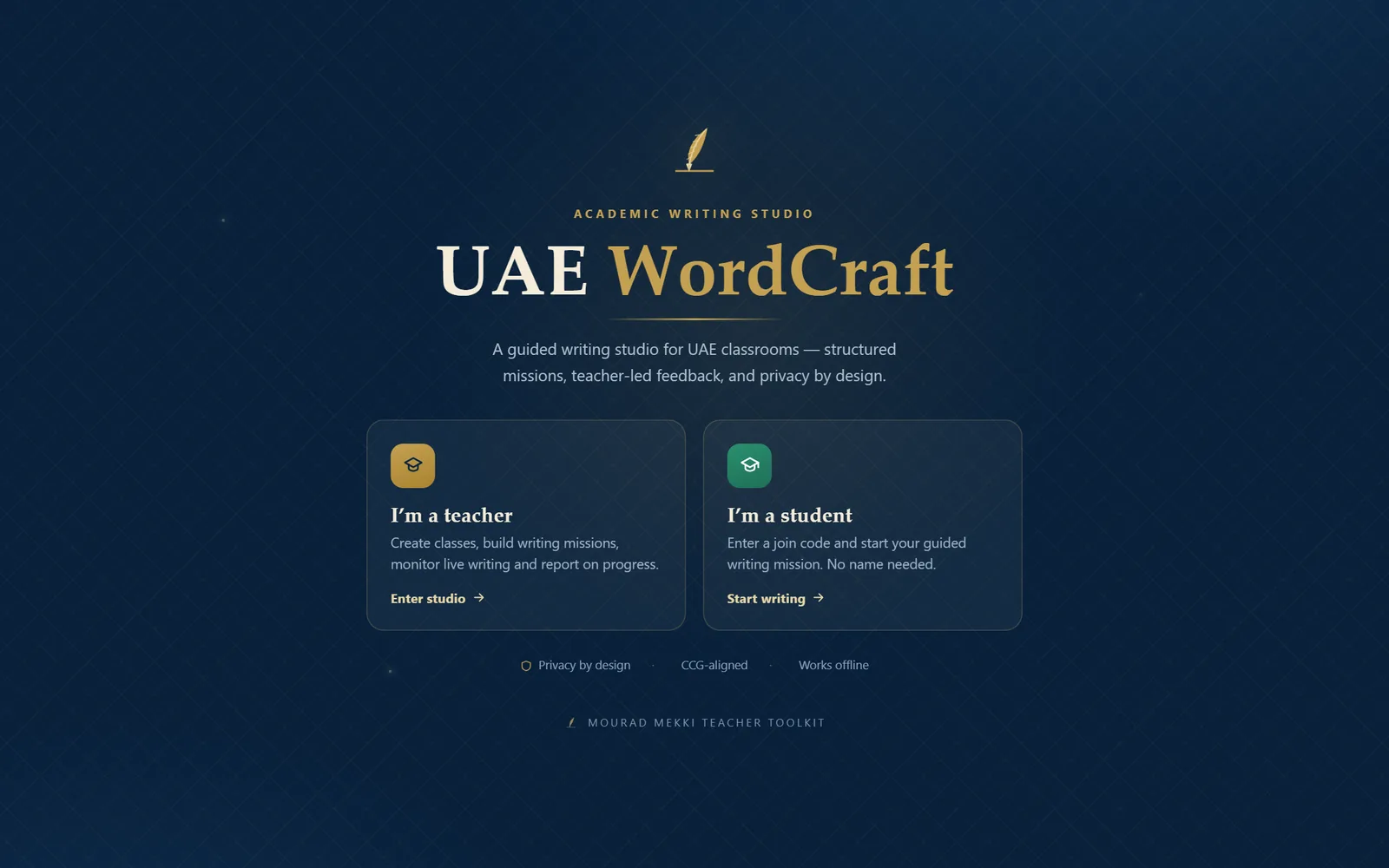
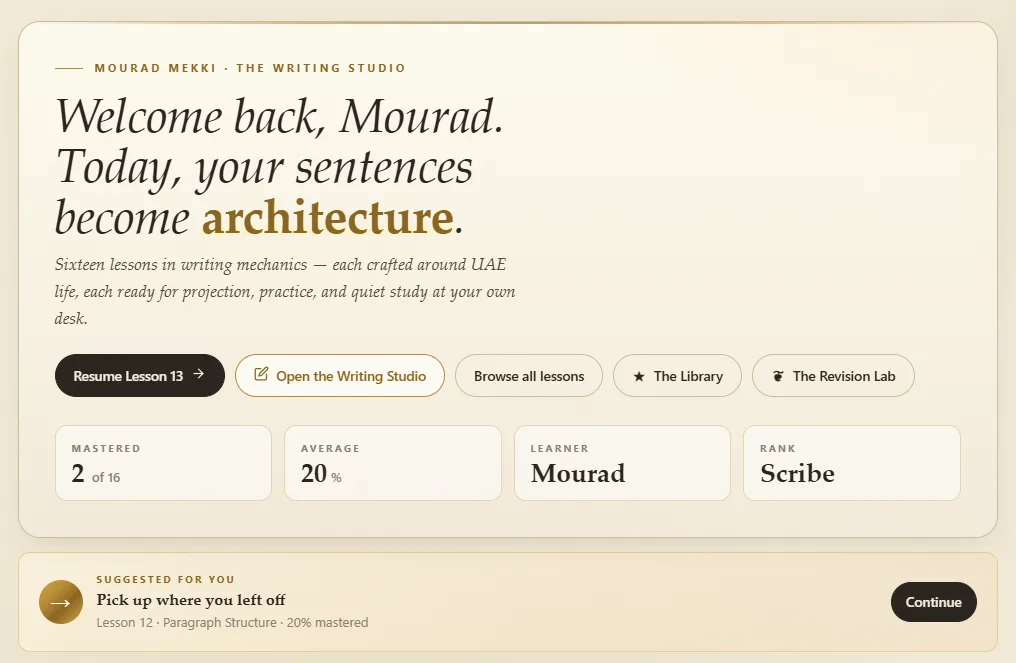
How it differs from its neighbours: UAE WordCraft is an academic writing studio with teacher annotation and rubric scoring; Writing Mechanics is a sixteen-lesson mechanics course still in development. Kātib is the scaffold between them — matched to the lesson, built in stages, and never marked.
Inside the product
The writing ladder
Four stages for every lesson. The examples are taken from Grade 12 General, Chapter 1 (“Money… Talks!”), Lessons 7–8.
- WordsMeanings, partners, spelling
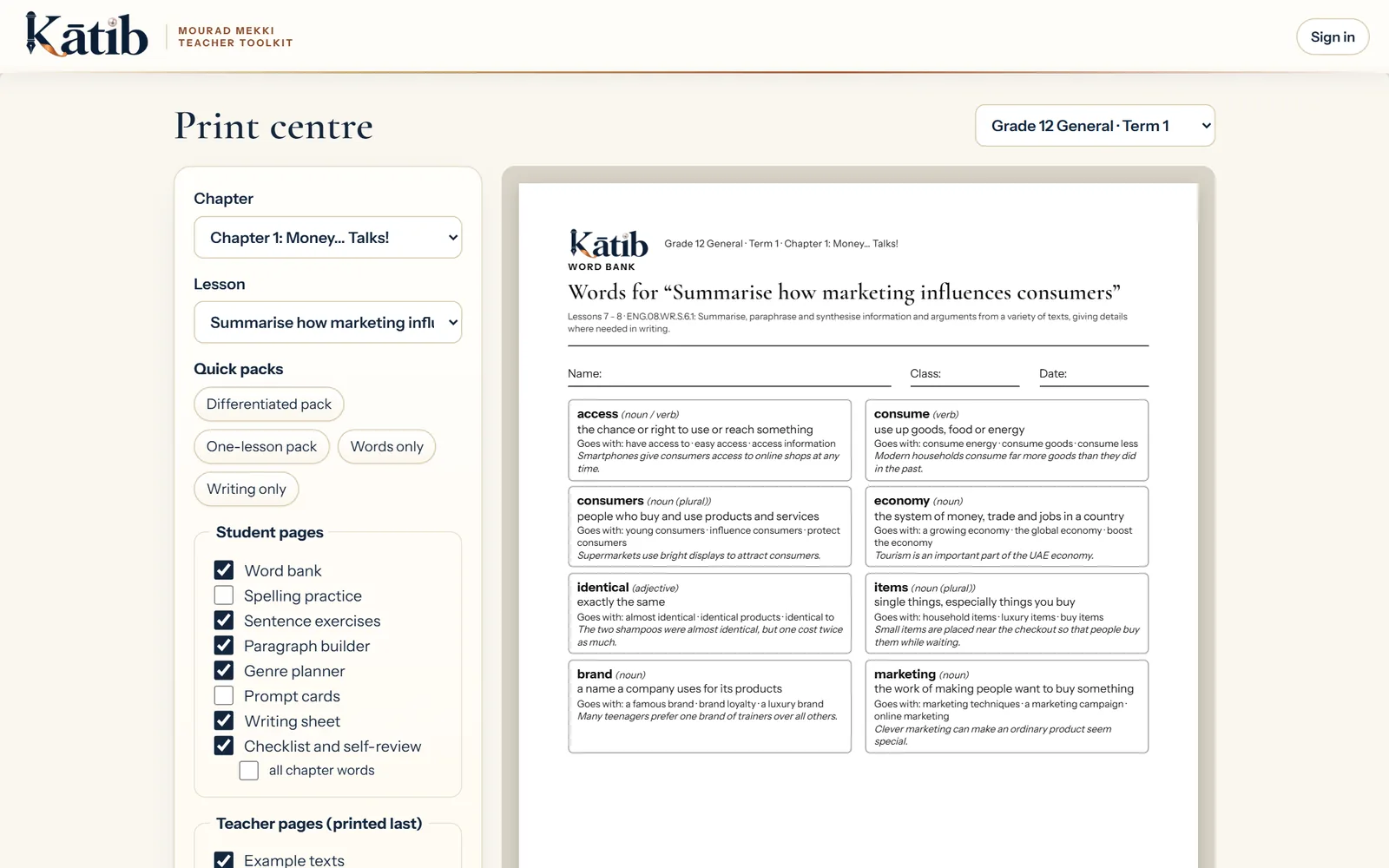
consume — use up goods, food or energy
يستهلك - SentencesOrder, complete, combine, expand
Essential items ___ at the back of the store.
- ParagraphsTopic sentence to closing
Our research shows that consumers are influenced by…
- WritingPlan, draft, check, improve — a 120–170-word summary
My findings · Group them · Effect on consumers · Overall point
Free writing adds five essay types — opinion, discussion, advantages and disadvantages, problem and solution, double question — at three bands, each with model essays and a five-part plan.
Students and teachers
What students can do
- Build a piece of writing in four stages, at their own help level
- Switch on Arabic help in the word bank
- Use frames, sentence starters, planners and a six-point checklist
- Practise without an account — work is saved on the device
What teachers can do
- Assign units and preview them as a student
- Print differentiated packs: word bank, spelling, sentence exercises, paragraph builder, planner, writing sheet and checklist
- Follow class progress through activity — never marks — and add a short comment
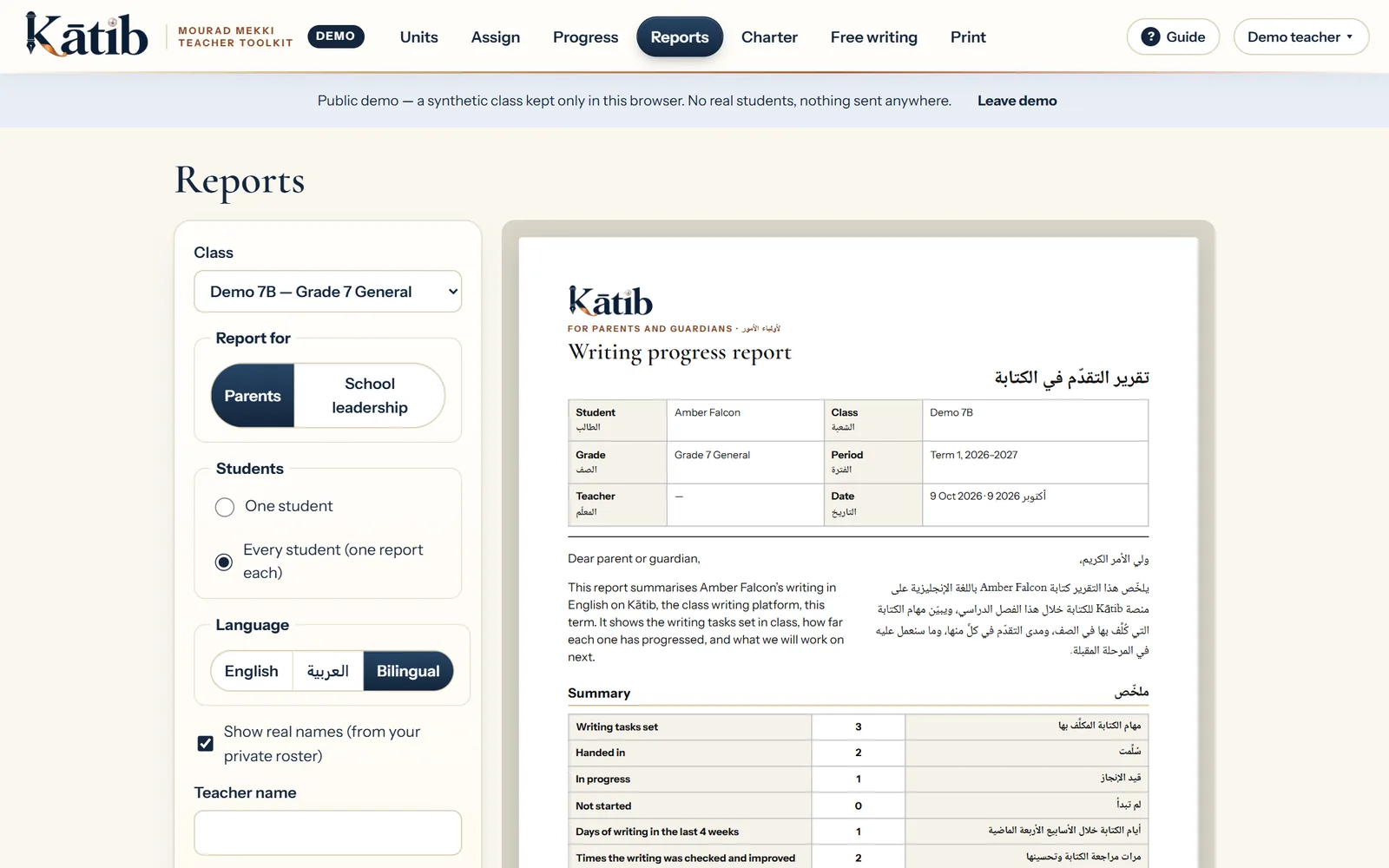
- Send reports to parents and leaders in English, Arabic or both
Curriculum, print and privacy
- Curriculum
- UAE English CCG, Term 1, Grades 5–12, General and Advanced: 72 writing lessons drawn from 16 curriculum documents, 71 of them with a writing outcome. Terms 2 and 3 are not claimed.
- A print centre for every lesson: word bank, spelling, sentence exercises, paragraph builder, genre planner, prompt cards, writing sheet, checklist and teacher answer pages.
- Languages
- English writing with optional Arabic help in the word bank; parent and leadership reports in English, Arabic or bilingual.
- Privacy & data
- Checks run on the device — text is not sent to any grammar service or AI. No adverts, tracking or analytics. Class accounts use Google Firebase; the owner sees monthly totals only, never students’ names or writing.
Evidence
- Measured outcomes
- No measured attainment data is published for this platform. Descriptions above cover what the product does, not proven results.
- Verification
- Checked on the live site and its public demo class (“a synthetic class kept only in this browser”), 9 October 2026, including the curriculum coverage page built on 5 October 2026. The supplied address is Kātib itself, not a separate toolkit entry page.
Related work
-
 Reading & writingNo. 05
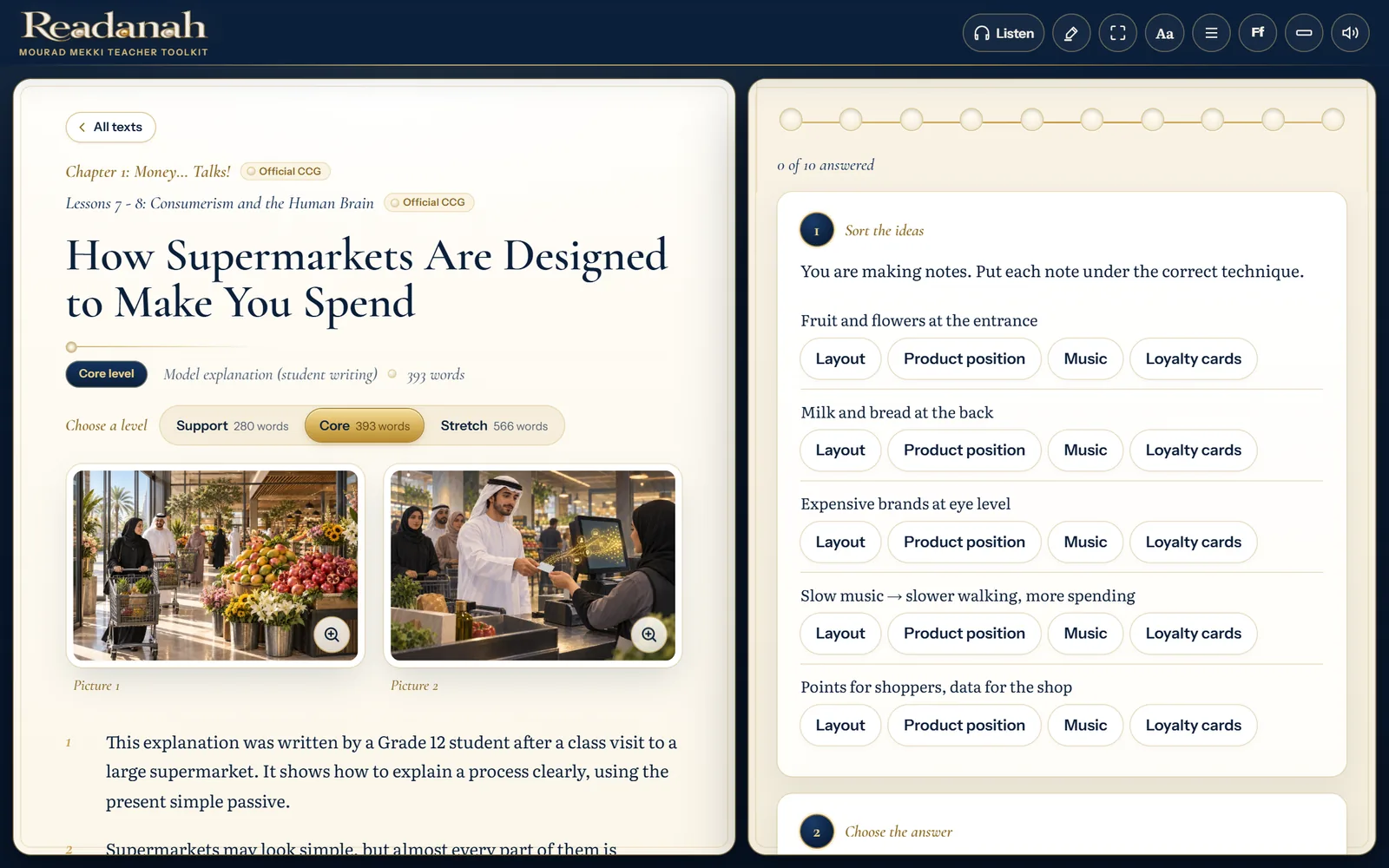
Readanah
Graded reading built on the UAE English curriculum: texts at three levels with two pictures each, questions answered by tapping, a pearl for every text, and reports in English, Arabic or both.
Students & teachers · Cycle 2 & 3 · Grades 5–12
Live · Term 1, 2026–2027 Open -
 Reading & writingNo. 07
UAE WordCraft
An academic writing platform for the curriculum’s writing tasks, with teacher annotations that land directly on the student’s draft.
Students & teachers · Cycle 3
Live · Term 1, 2026–2027 Open -
 Reading & writingNo. 29
Writing Mechanics
Sixteen lessons from capital letters to complete paragraphs, every one set in UAE contexts. In development — no public link yet.
Students · UAE secondary
In development